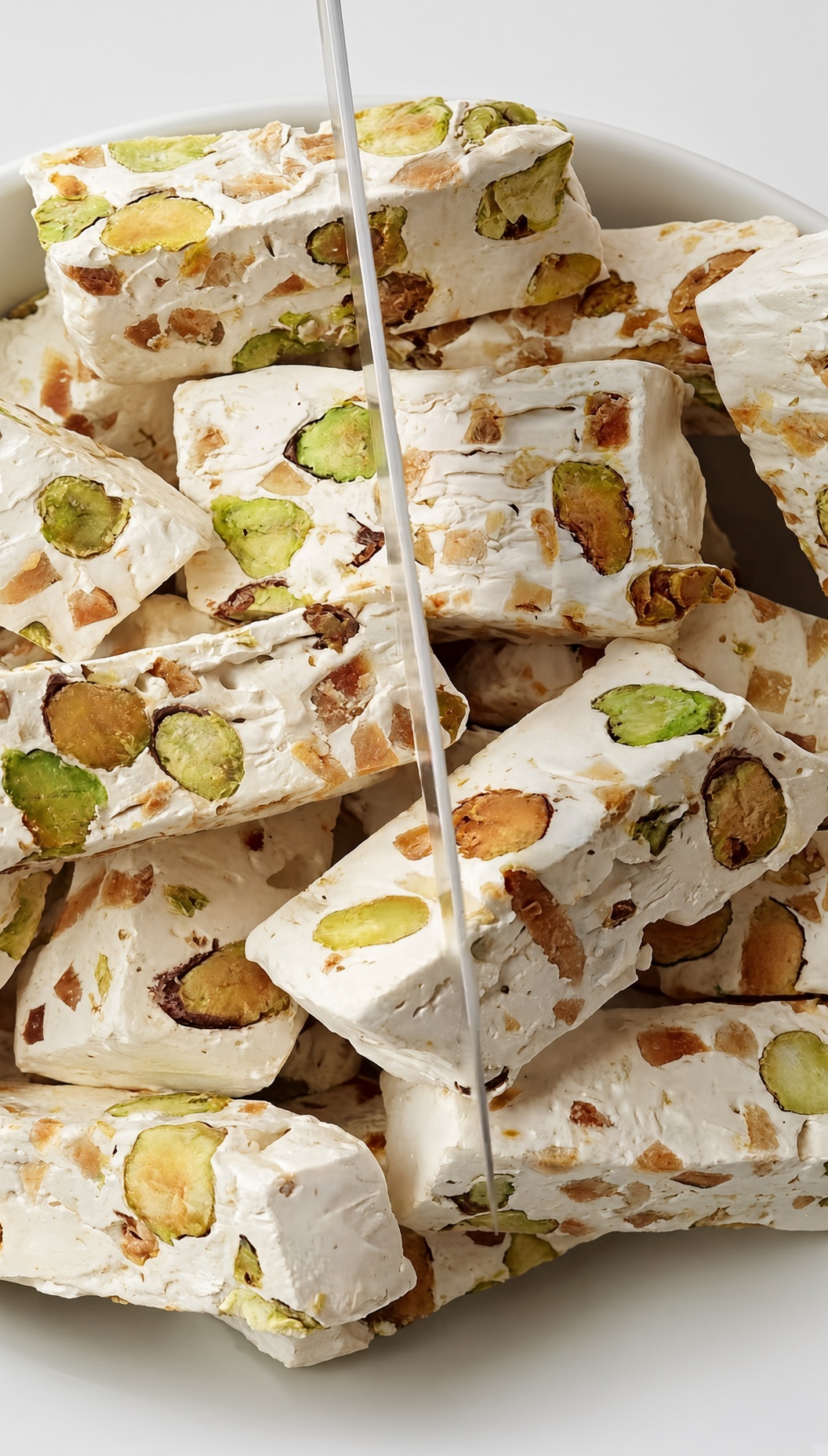
Pistachio Almond Honey Nougat
There is something wonderfully special about homemade pistachio almond honey nougat. With its pale, delicate colour, generous pieces of green pistachio and golden toasted almonds, this classic confection looks every bit as beautiful as it tastes. Each slice offers a satisfying combination of sweet honey flavour, nutty richness and a tender, chewy texture.
Unlike many everyday sweets, traditional nougat relies on a fascinating combination of cooked sugar syrup and whipped egg whites. The syrup creates structure, while the egg whites introduce air and help produce that distinctive light-looking interior. Whole nuts are then folded through the mixture, adding colour, crunch and a wonderfully rich flavour.
This pistachio almond honey nougat recipe is particularly appealing during Christmas and other celebrations. The finished bars make elegant additions to homemade sweet boxes, festive dessert platters and edible gifts. Wrapped individually in wax paper, they also look beautiful arranged in small gift tins.
Honey provides a warm, floral sweetness, while pistachios contribute their characteristic earthy flavour. Toasted almonds introduce another layer of nuttiness and a contrasting crunch. Together, these simple ingredients create a confection that feels luxurious without requiring a long list of specialist flavourings.
Making nougat at home does require attention to temperature and timing. A reliable sugar thermometer, a sturdy electric mixer and a little preparation make an enormous difference. Once the hot syrup is ready, the process moves quickly, so having everything measured and waiting is essential.
Whether you are trying homemade torrone for the first time or looking for an impressive holiday sweet, this guide explains the entire process, from cooking the honey syrup to cutting beautifully shaped nougat bars.
Recipe Overview
- Recipe: Pistachio Almond Honey Nougat
- Category: Homemade sweets and confectionery
- Style: Mediterranean-inspired, Italian-style nougat
- Preparation time: Approximately 20–25 minutes
- Cooking and mixing time: Approximately 25–40 minutes, depending on the cooker and mixer
- Setting time: Several hours, preferably overnight
- Estimated total time: Approximately 9–14 hours when allowing for an overnight set
- Yield: Approximately 24 pieces
- Cooking method: Stovetop sugar syrup, whipped egg whites and room-temperature setting
- Oven temperature: Not required when using already-toasted nuts
- Pan: 8 x 8-inch square pan (approximately 20 x 20 cm)
- Key syrup temperature: 285–290°F (140–143°C)
- Main ingredients: Sugar, honey, glucose syrup, egg whites, pistachios and almonds
Important: The sugar temperature is the central measurement in this recipe. Use a proper sugar thermometer instead of estimating readiness from colour alone. The actual final texture will also depend on humidity, syrup composition and how long the mixture is beaten.
Why You’ll Love This Recipe
- Beautiful presentation: The combination of ivory-coloured nougat and bright green pistachios creates an attractive confection without artificial colouring.
- Wonderful nutty flavour: Pistachios and toasted almonds provide richness and natural crunch.
- Honey sweetness: Honey adds a distinctive depth of flavour beyond plain sugar.
- Excellent for gifting: Individual bars can be wrapped in decorative food-safe paper and arranged in festive tins.
- No baking required: The primary cooking process happens on the stovetop.
- Make-ahead friendly: Nougat is designed to rest and set before cutting.
- Customisable: The nut mixture can be adjusted through clearly defined variations.
- Rewarding technique: Learning to combine cooked syrup with whipped egg whites opens the door to other traditional confectionery recipes.
Ingredients for Pistachio Almond Honey Nougat
This recipe uses the exact ingredients and quantities provided in the original method.
For the Honey Nougat Base
- 2 cups granulated sugar (approximately 400 g)
- 1 cup honey (approximately 340 g)
- 1/2 cup glucose syrup or light corn syrup (approximately 160–170 g, depending on the product)
- 2 large egg whites, at room temperature
- 1 teaspoon vanilla extract
- Pinch of salt
For the Nut Filling
- 1 1/2 cups shelled pistachios
- 1 cup toasted almonds, roughly chopped
Optional Pan Lining
- Edible wafer paper or parchment paper, as needed
Ingredient preparation: Measure the nuts before beginning. If the almonds are not already toasted, toast them lightly and allow them to cool. Keep the vanilla extract, lined pan and sturdy spatula within easy reach.
Ingredient Notes and Substitutions
Granulated Sugar
Granulated sugar provides much of the nougat’s structure. When heated with honey and glucose syrup, it becomes part of a concentrated sugar mixture that sets as it cools.
Ordinary white granulated sugar works well because its flavour is neutral and it allows the honey and nuts to remain prominent.
Honey
Honey gives this confection its distinctive sweetness and aromatic character. A mild, good-quality honey is particularly suitable if you want the pistachio and almond flavours to stand out.
Stronger honey varieties can produce a more pronounced floral flavour. Choose one you genuinely enjoy eating.
Honey contains a mixture of sugars and varying amounts of water, so changing the honey variety can slightly influence cooking behaviour and finished texture.
Glucose Syrup or Light Corn Syrup
Glucose syrup helps manage sugar crystallisation and contributes to a smoother, less grainy confection. Light corn syrup performs a similar practical function.
These products may differ in thickness and sugar composition, so the final nougat texture can vary slightly between brands.
Avoid replacing either with an equal quantity of water or an unrelated liquid. Such substitutions can significantly change the confectionery process.
Egg Whites
Egg whites are essential to the characteristic structure of this style of nougat. When whipped, their proteins trap air and create a foam. The concentrated hot syrup is then incorporated into that foam.
For predictable whipping, use a clean bowl free from grease or egg yolk.
For food safety, pasteurised egg whites suitable for whipping are a useful option. Pouring hot sugar syrup into ordinary raw egg whites does not, by itself, guarantee that the entire mixture reaches a verified safe temperature. The finished mixture should reach a food-safe temperature throughout, or use a validated pasteurised-egg method.
Pistachios
Pistachios make this nougat visually striking. Their natural green colour contrasts with the pale candy base, while their rich flavour balances the sweetness.
Roasted, unsalted pistachios are particularly convenient. Very salty pistachios can dominate the delicate honey flavour.
Toasted Almonds
Toasted almonds bring a firm crunch and deeper roasted flavour. Rough chopping helps distribute them throughout the nougat while retaining satisfying pieces in every bite.
Whole almonds may also work, although the finished bars can be more difficult to slice neatly.
Vanilla Extract
Vanilla rounds out the flavour of the honey and nuts. Add it after the syrup has been incorporated into the whipped egg whites, as directed in the original recipe.
Salt
A small pinch of salt balances the sweet ingredients and supports the roasted nut flavours.
Wafer Paper Versus Parchment
Edible wafer paper is a traditional nougat covering that can remain attached to the sweet when served, provided the product is specifically labelled as edible and suitable for confectionery.
Parchment paper is a practical alternative for lining the pan, but must be peeled away before eating.
Equipment You’ll Need
- Heavy-bottomed saucepan: Promotes more even heating of the sugar and honey mixture.
- Reliable sugar thermometer: Measures the syrup accurately up to 290°F (143°C).
- Electric stand mixer or sturdy hand mixer: Whips the egg whites and incorporates the hot syrup. A stand mixer makes controlled pouring easier.
- Heat-resistant mixing bowl: Suitable for the hot syrup mixture.
- 8 x 8-inch square pan: Shapes the nougat into a thick slab.
- Parchment or edible wafer paper: Helps release or cover the finished nougat.
- Heat-resistant spatula: Useful for mixing in nuts and transferring the sticky mixture.
- Sharp knife: Cuts the set nougat into individual pieces.
- Kitchen scales and measuring cups: Help maintain consistent proportions.
- Heat-resistant gloves: Provide additional protection when handling hot equipment.
How to Make Pistachio Almond Honey Nougat
Step 1: Prepare the Square Pan
Line an 8 x 8-inch square pan with parchment paper or edible wafer paper.
If using parchment, leave enough overhang to help lift the finished slab. Smooth the paper neatly into the corners so the nougat forms an even shape.
Step 2: Prepare the Almonds
If your almonds are not already toasted, lightly toast them and allow them to cool.
Roughly chop the almonds into pieces large enough to provide texture but not so large that they make slicing difficult.
Step 3: Measure the Nuts
Place the pistachios and toasted almonds in a bowl, ready to use.
This preparation matters because the nougat becomes increasingly difficult to handle as it cools.
Step 4: Combine the Syrup Ingredients
Add the granulated sugar, honey and glucose syrup or light corn syrup to a heavy-bottomed saucepan.
Set the saucepan over medium-low heat.
Step 5: Dissolve the Sugar
Heat gently until the sugar dissolves.
During this early stage, gently stir as needed to help combine the ingredients without splashing sugar crystals around the sides of the pan.
Step 6: Cook to the Correct Temperature
Continue heating the syrup until it reaches approximately 285–290°F (140–143°C).
Use a sugar thermometer and monitor the mixture carefully. Once the syrup approaches the target, its temperature can rise quickly.
Keep hands and face away from splashes. Hot sugar syrup can cause serious burns.
Step 7: Whip the Egg Whites
While the syrup cooks, place the two room-temperature egg whites in a clean mixing bowl with the pinch of salt.
Beat until soft peaks form.
Soft peaks should hold briefly before their tips bend over. Avoid beating the whites until they become excessively stiff and dry.
Step 8: Reduce the Mixer Speed
Turn the electric mixer to low speed before adding the cooked syrup.
Position the saucepan carefully so you can control the stream without leaning over the hot liquid.
Step 9: Add the Hot Syrup Slowly
With the mixer running, carefully pour the hot syrup into the egg whites in a thin, steady stream.
Aim between the whisk and the side of the bowl rather than directly onto the moving beaters, where the syrup could splash.
Take your time. Adding the syrup too quickly can cause localised cooking of the egg whites and create an uneven mixture.
Step 10: Continue Beating
Once all the syrup has been incorporated, increase the mixer speed slightly.
Keep mixing as the egg-white mixture thickens.
Step 11: Check the Nougat Consistency
Continue beating until the mixture becomes thick, glossy and very sticky.
It should look denser and more substantial than ordinary whipped egg whites, with enough body to hold the nuts throughout.
If using ordinary, unpasteurised eggs, a validated food-safe preparation and temperature check is essential; the syrup temperature alone does not confirm the final mixture’s safety.
Step 12: Add Vanilla
Mix in the vanilla extract until evenly distributed.
Step 13: Fold in the Nuts
Add the pistachios and toasted almonds.
Using a sturdy spatula, fold them through the nougat until distributed as evenly as possible.
Take care because the mixture may still be hot.
Step 14: Work Quickly
Once the nuts have been incorporated, prepare to transfer the nougat immediately.
The mixture gradually becomes firmer as it cools, so avoid unnecessary delays.
Step 15: Transfer to the Prepared Pan
Spoon or scrape the mixture into the lined square pan.
Spread it towards the corners.
Step 16: Press into an Even Layer
Press the nougat firmly and evenly into the pan with a suitable heat-resistant tool.
Try to create a consistent thickness so every finished piece has a similar shape.
Step 17: Smooth the Surface
Smooth the top using a lightly greased spatula or a second sheet of parchment paper.
If using edible wafer paper, an additional sheet can be placed on top, following the manufacturer’s instructions.
Step 18: Allow the Nougat to Set
Leave the nougat at cool room temperature for several hours, preferably overnight.
Protect it from excess moisture while it rests.
The slab should become firm enough to lift and cut without losing its shape.
Step 19: Remove from the Pan
Once set, carefully lift the nougat slab from the square pan.
Remove any parchment from the base or sides. Edible wafer paper can remain in place if intended for consumption.
Step 20: Cut into Bars
Use a sharp, lightly oiled knife to cut the slab into thick rectangular bars or squares.
For approximately 24 pieces, cut the slab into a grid of suitably sized portions.
Step 21: Clean the Knife Between Cuts
If the nougat sticks, wipe the knife and apply a very thin layer of neutral cooking oil before continuing.
This helps produce cleaner edges and makes it easier to cut through the embedded nuts.
Why Sugar Syrup Temperature Matters
The most important technical detail in homemade pistachio almond honey nougat is cooking the syrup correctly.
What Happens When Sugar Syrup Heats?
As the mixture heats, moisture evaporates and the concentration of dissolved sugars increases. That concentration strongly influences the way the finished confection sets.
A more concentrated syrup generally creates a firmer result than a less concentrated one, although honey composition, glucose syrup, egg-white foam and mixing time all influence the final texture.
Why This Recipe Uses 285–290°F
The original recipe specifies 285–290°F (140–143°C), a high-temperature stage of sugar cooking associated with a relatively concentrated syrup.
This temperature is intended to give the mixture sufficient structure to form sliceable bars after whipping and resting.
What If the Syrup Is Too Cool?
If the syrup is removed significantly before reaching the intended temperature, excess moisture may leave the finished nougat softer, stickier or less able to hold its shape.
A syrup that is slightly below the specified range does not always produce complete failure, but the risk of an excessively soft texture increases.
What If the Syrup Is Too Hot?
Overheating may produce a firmer, more brittle result. It may also deepen the flavour and colour of the sugars beyond what is intended for this pale confection.
Do not deliberately increase the temperature to make the recipe set faster.
How to Use a Sugar Thermometer Properly
Keep the sensing end in the syrup without touching the bottom of the saucepan, unless the thermometer’s instructions specify otherwise.
Follow the manufacturer’s immersion-depth guidance and monitor the syrup closely as it approaches the target.
Professional tip: Check your thermometer’s accuracy periodically. Even a relatively small temperature error can influence confectionery texture.
How to Whip Egg Whites for Homemade Nougat
Start With Clean Equipment
Egg whites whip most effectively in a clean bowl without traces of fat. Even small amounts of yolk can interfere with foam formation.
Use Room-Temperature Whites
The original recipe calls for room-temperature egg whites. These are generally easier to whip into a light foam than very cold whites.
For safety, do not leave eggs out longer than necessary, especially in a warm kitchen.
Understand Soft Peaks
When the whisk is lifted, soft peaks should briefly hold their shape and then gently curl.
This creates a useful foundation for the incoming hot syrup.
Pour Slowly and Carefully
The hot syrup needs to be incorporated gradually. A thin stream gives the mixer time to distribute the concentrated sugar mixture throughout the foam.
Pouring directly onto moving beaters can cause splashing, while adding syrup all at once can create dense or uneven areas.
Beat Until Thick and Glossy
As the mixture is beaten, it should become noticeably heavier, thicker and more resistant to movement.
The exact mixing time varies depending on your mixer, bowl and batch temperature.
Do not rely on a fixed number of minutes alone. Watch the texture.
Food Safety With Egg Whites
Traditional hot-syrup confectionery techniques do not automatically guarantee that every part of a whipped-egg mixture reaches a temperature sufficient to eliminate harmful microorganisms.
Using pasteurised egg whites that are suitable for whipping is the simpler approach for home cooks, particularly when serving children, older adults, pregnant people or anyone with a weakened immune system.
If using unpasteurised egg whites, employ a properly validated heating method and verify the resulting temperature throughout the mixture. The original syrup temperature is not a substitute for checking the combined mixture.
How to Achieve Beautiful, Sliceable Nougat
Balance Air and Structure
Nougat needs enough air to create its distinctive light interior, but sufficient sugar structure to hold together once cut.
Too little mixing can leave the mixture loosely structured. Excessive mixing may make it difficult to fold in the nuts before the nougat becomes too firm.
Use the Right Nut Texture
Whole pistachios create attractive green shapes in each slice. Roughly chopped almonds provide smaller golden pieces that fill the spaces between them.
This combination produces a varied appearance and pleasant texture.
Mix Nuts Evenly
Fold from the bottom of the bowl upwards, turning the mixture until the nuts are distributed throughout.
A sturdy spatula is especially useful because nougat becomes increasingly resistant as it cools.
Press the Mixture Firmly
Pressing the nougat evenly into its pan minimises large gaps and helps give the finished pieces consistent edges.
Do not attempt to press hot nougat directly with bare hands.
Let the Slab Rest
Cutting too early can cause the nougat to stretch, smear or lose its shape.
Several hours of setting time are recommended in the original recipe, with overnight resting preferred.
Consider Kitchen Humidity
Nougat contains hygroscopic sugars, including those naturally present in honey. These sugars readily interact with moisture in the surrounding air.
A humid kitchen can leave the exposed surfaces sticky even when the interior has set well.
Choose a cool, reasonably dry space for resting and storing the confection.
13 Expert Tips for Better Homemade Nougat
- Measure everything first. You will have very little time to search for ingredients once the syrup reaches temperature.
- Use a heavy saucepan. Even heating reduces the risk of localised scorching.
- Choose a reliable thermometer. Temperature accuracy matters more than guessing from bubbling or colour.
- Select a honey you enjoy. Its flavour remains noticeable in the finished confection.
- Use unsalted nuts. They allow better control over the final flavour.
- Prepare nuts before cooking syrup. The mixture begins setting as it cools.
- Have your mixer ready. Timing is easier when the egg whites can reach soft peaks as the syrup approaches the required temperature.
- Reduce mixer speed before pouring. This helps control the incorporation of the dangerously hot syrup.
- Avoid splashing the syrup. Keep it away from the whisk itself and from exposed skin.
- Check the foam’s consistency. Thick, glossy nougat is more informative than an arbitrary mixing time.
- Line the pan carefully. An even lining produces cleaner edges and easier removal.
- Choose a dry setting area. Excess humidity encourages surface stickiness.
- Use a lightly oiled knife. A little neutral oil can make cutting significantly easier.
Common Nougat Mistakes and How to Avoid Them
1. Nougat That Is Too Sticky
Possible causes: Syrup that did not reach the required temperature, high humidity, insufficient mixing or cutting before the slab had set.
Prevention: Measure the syrup temperature carefully, beat to the appropriate consistency and leave the nougat undisturbed until firm.
2. Nougat That Is Too Hard
Possible causes: Overheated sugar syrup or excessive concentration of sugars.
Prevention: Remove the syrup from the heat at the specified temperature rather than cooking beyond the range.
3. Grainy Nougat
Possible cause: Unwanted sugar crystallisation.
Prevention: Dissolve the sugar carefully, avoid splashing undissolved crystals onto the pan walls and use the specified glucose or corn syrup.
4. Unevenly Distributed Nuts
Possible cause: The nougat became too firm before the nuts were incorporated.
Prevention: Measure the nuts in advance and fold them in promptly.
5. Egg Whites That Do Not Whip Properly
Possible cause: Grease or egg yolk in the bowl.
Prevention: Clean and dry the bowl and beaters thoroughly before starting.
6. Lumps After Adding Syrup
Possible cause: Pouring hot syrup too quickly or directly against the beaters.
Prevention: Add it in a controlled thin stream while mixing continuously.
7. Nougat That Sticks to the Pan
Possible cause: Insufficient lining.
Prevention: Cover the base and sides properly before adding the mixture.
8. Messy or Uneven Bars
Possible cause: Cutting too early or using a sticky, blunt knife.
Prevention: Let the slab set completely, then slice with a sharp, lightly oiled blade.
9. Loss of Fresh Nut Flavour
Possible cause: Old or poorly stored nuts.
Prevention: Taste the nuts before cooking and discard any with stale or rancid flavours.
Optional Pistachio Nougat Variations
The following are optional adaptations, not ingredients included in the original recipe. Changing the proportions or type of nuts may affect flavour, cutting and texture.
1. Classic Almond Honey Nougat
For a more traditional almond-forward version, replace the pistachios with additional toasted almonds. Keep the total nut volume approximately the same.
2. Extra Pistachio Nougat
Replace some of the almonds with more pistachios for a greener appearance and stronger pistachio flavour.
3. Orange-Scented Nougat
Add a small amount of finely grated orange zest with the vanilla for a fresh citrus aroma. Use only the coloured outer zest, avoiding the bitter white pith.
4. Rosewater Pistachio Nougat
Add a very small quantity of culinary rosewater as an optional flavouring. Start conservatively, as its fragrance can easily overpower the honey and nuts.
5. Hazelnut Almond Nougat
Replace a portion of the pistachios with roasted, skinned hazelnuts for an earthier nut flavour.
6. Holiday Cranberry Nougat
Fold in a modest quantity of thoroughly dried cranberries in place of some of the nuts. Be aware that changing the balance of inclusions may influence cutting and texture.
7. Chocolate-Dipped Nougat
Once the nougat is fully set and sliced, dip part of each bar into tempered or properly melted chocolate and let the coating firm up. This is an optional finishing technique, not part of the original recipe.
How to Serve Pistachio Almond Honey Nougat
On a Christmas Sweet Platter
Arrange the nougat alongside homemade shortbread, chocolate truffles and other festive confectionery. Its pale colour and green nuts create attractive contrast.
With Coffee
Serve a small piece with espresso or strong coffee. The slight bitterness of the drink balances the honey sweetness.
With Tea
A cup of Earl Grey, black tea or lightly scented herbal tea pairs beautifully with the delicate honey flavour.
In Homemade Gift Boxes
Wrap each bar in food-safe wax paper and arrange the pieces inside a decorative tin or gift box.
Include a note identifying the tree nuts and egg ingredients for recipients with allergies.
As a Dessert-Board Addition
Place smaller squares alongside fresh fruit, dark chocolate and biscuits for an elegant after-dinner presentation.
For Weddings and Special Occasions
Small individually wrapped nougat pieces can be attractive edible favours when stored and handled correctly.
Storage, Shelf Life and Make-Ahead Advice
Room-Temperature Storage
The original recipe recommends wrapping individual pieces in parchment or wax paper and storing them in an airtight container at cool room temperature for up to 1–2 weeks.
That duration is best treated as a suggested quality window, not a guaranteed food-safety shelf life. Homemade nougat’s safety and keeping quality depend on the egg treatment, final moisture content, hygiene and storage conditions.
For longer storage, a validated confectionery process and appropriate shelf-life assessment are preferable.
Keep Away From Humidity
Store the nougat in a dry area away from steam, direct sunlight and warm appliances.
Moisture can soften the surface and make individual bars stick together.
Should Nougat Be Refrigerated?
Refrigeration may cause condensation when the nougat returns to room temperature, making the surface sticky.
However, if the egg preparation has not been validated as shelf-stable, do not assume room-temperature storage is safe. Use pasteurised eggs and an appropriate food-safe process, and refrigerate promptly when required by the preparation or ingredient instructions.
Can You Freeze Homemade Nougat?
Freezing is possible, although texture changes and condensation can occur after thawing.
Wrap pieces individually, protect them from freezer moisture and thaw in their sealed packaging to limit surface condensation.
Freezing does not make an otherwise unsafe preparation safe.
Make-Ahead Preparation
The nougat is well suited to preparation ahead of an occasion because the original method already requires several hours of setting, preferably overnight.
For the neatest presentation, allow the slab to firm up fully before cutting and wrapping.
Does Nougat Need Reheating?
No. This is a ready-to-eat confection after it has been properly prepared and set.
Heating finished nougat can change its structure and is not recommended as a normal serving step.
Frequently Asked Questions
1. What is pistachio almond honey nougat?
It is a sweet confection made by combining concentrated sugar and honey syrup with whipped egg whites, then folding in pistachios and almonds. The mixture sets into a sliceable slab.
2. Is this similar to Italian torrone?
Yes. The ingredients and technique are similar to certain Italian-style torrone recipes, particularly those featuring honey, whipped egg whites and nuts. Traditional regional methods and textures vary.
3. Is homemade nougat difficult to make?
It requires more precision than a simple no-bake dessert because sugar temperature and mixing technique affect the outcome. With the right equipment and advance preparation, it is manageable for careful home cooks.
4. Why do I need a sugar thermometer?
The thermometer allows you to measure the syrup’s concentration indirectly through temperature. Guessing based on appearance can lead to inconsistent results.
5. Can I make nougat without glucose syrup?
Glucose syrup is part of the supplied recipe and helps control crystallisation. Removing it would require a properly tested alternative formula rather than simply omitting it.
6. Can I use light corn syrup instead?
Yes. The original recipe specifically offers light corn syrup as an alternative to glucose syrup.
7. Which honey is best?
A mild honey generally allows the pistachio and almond flavours to shine. A stronger honey gives the finished bars a more pronounced aroma.
8. Can I use salted pistachios?
Unsalted pistachios are recommended. Salted pistachios can alter the sweet-savoury balance considerably.
9. Do the almonds need to be toasted?
The original recipe calls for toasted almonds. Toasting gives them a deeper flavour and satisfying crunch.
10. Can I replace the almonds with other nuts?
Yes, as an optional variation. Hazelnuts or additional pistachios are reasonable choices, although the overall nut size and texture may change the cutting experience.
11. Why is my nougat too soft?
Possible causes include an undercooked syrup, insufficient beating, high ambient humidity or cutting before the slab has set.
12. Why is my nougat very hard?
The syrup may have become too concentrated during cooking. Check the thermometer and avoid heating beyond the intended range.
13. Why does my nougat look grainy?
Graininess can result from unwanted sugar crystallisation. Proper dissolving and the inclusion of glucose or corn syrup help reduce this risk.
14. Can I make nougat without egg whites?
There are egg-free nougat-style sweets, but they require different ingredients and formulation. Removing the egg whites from this recipe would substantially change the result.
15. Are raw egg whites safe in this recipe?
Not automatically. Hot syrup alone does not prove that all of the combined egg-white mixture has reached a food-safe temperature. Pasteurised egg whites suitable for whipping are recommended for a safer home preparation.
16. What is edible wafer paper?
It is a thin edible sheet designed for confectionery. It can help prevent sticking and gives nougat a traditional finish. Check the ingredients and intended use before purchasing.
17. Can I use parchment instead of wafer paper?
Yes. Parchment is specifically listed as an alternative in the original recipe. Unlike edible wafer paper, it must be removed before eating.
18. How long should the nougat set?
Several hours are recommended, preferably overnight. The slab should feel firm enough to slice cleanly before you remove it from the pan.
19. How do I cut nougat without sticking?
Use a sharp knife with a very light coating of neutral oil. Wipe and re-oil the blade when necessary.
20. Can I make this recipe in a larger pan?
Yes, but the slab will be thinner if the ingredient quantities remain unchanged. A larger batch would need appropriately scaled ingredients and a suitable saucepan and mixer.
21. Is this nougat gluten-free?
The main ingredients do not inherently require wheat flour, but glucose syrup, wafer paper and other packaged products should be checked for gluten-containing ingredients or cross-contact if preparing food for someone with coeliac disease.
22. Does this recipe contain allergens?
Yes. It contains egg whites, pistachios and almonds. Check all packaged ingredients and prevent cross-contact when serving people with food allergies.
23. Can I add chocolate?
Yes. Once the nougat is set and sliced, you can dip the pieces in chocolate as an optional variation.
24. How many pieces does the recipe make?
The supplied recipe yields approximately 24 pieces, depending on how the slab is cut.
25. Is homemade nougat suitable for Christmas gifts?
Yes, when prepared, stored and handled safely. Its attractive appearance makes it a lovely addition to a festive sweet tin. Clearly label the egg and tree-nut allergens.
Complete Recipe Card
Homemade Pistachio Almond Honey Nougat
Description: A beautiful homemade honey nougat filled with green pistachios and toasted almonds. This traditional-style confection is sweet, nutty, chewy and ideal for festive sweet platters or carefully wrapped edible gifts.
- Category: Sweets and confectionery
- Style: Mediterranean-inspired
- Method: Stovetop and electric mixer
- Preparation: Approximately 20–25 minutes
- Cooking and mixing: Approximately 25–40 minutes
- Setting: Several hours, preferably overnight
- Yield: Approximately 24 pieces
- Pan size: 8 x 8 inches
- Syrup temperature: 285–290°F (140–143°C)
Ingredients
- 2 cups granulated sugar
- 1 cup honey
- 1/2 cup glucose syrup or light corn syrup
- 2 large egg whites, room temperature
- 1 1/2 cups shelled pistachios
- 1 cup toasted almonds, roughly chopped
- 1 teaspoon vanilla extract
- Pinch of salt
- Edible wafer paper or parchment paper, optional
Instructions
- Line an 8 x 8-inch square pan with parchment or edible wafer paper.
- Lightly toast the almonds if needed and let them cool.
- Measure the pistachios and almonds and keep them nearby.
- Combine the sugar, honey and glucose or light corn syrup in a heavy-bottomed saucepan.
- Heat over medium-low heat until the sugar dissolves.
- Continue cooking until the syrup reaches 285–290°F (140–143°C).
- While the syrup cooks, beat the egg whites with the salt until soft peaks form.
- Reduce the mixer speed to low.
- Carefully pour the hot syrup into the egg whites in a thin, steady stream while mixing continuously.
- Once the syrup is incorporated, increase the mixer speed slightly.
- Beat until the mixture becomes thick, glossy and very sticky.
- Mix in the vanilla extract.
- Fold in the pistachios and toasted almonds with a sturdy spatula.
- Work quickly because the nougat begins setting as it cools.
- Transfer the mixture to the prepared pan.
- Press firmly and evenly into the corners.
- Smooth the top with a lightly greased spatula or another sheet of parchment.
- Allow the nougat to set at room temperature for several hours, preferably overnight, provided the preparation has been made food-safe and is suitable for room-temperature setting.
- Lift the firm slab from the pan.
- Cut into thick rectangular bars or squares with a sharp, lightly oiled knife.
- Wipe and lightly oil the knife between cuts if necessary.
Helpful Recipe Notes
- Prepare all ingredients and equipment before cooking the sugar syrup.
- Use a reliable sugar thermometer for the most consistent texture.
- Add hot syrup gradually to avoid splashing and uneven incorporation.
- Use roasted, unsalted nuts for a well-balanced flavour.
- Fold the nuts into the nougat promptly before the mixture firms up.
- Allow adequate setting time for cleaner cutting.
- Store away from excess heat and humidity.
- Use pasteurised whipping egg whites or a validated safe egg-heating method. The hot syrup temperature alone does not establish the safety of the combined mixture.
Storage
Individually wrap properly prepared, shelf-stable nougat in parchment or wax paper and store in an airtight container in a cool, dry environment. The original recipe suggests 1–2 weeks for quality, but this is not a verified food-safety shelf life. Storage requirements depend on the final preparation and moisture content.
Nutritional Information
Yield: Approximately 24 pieces.
Original supplied estimates per piece:
- Calories: 165 kcal
- Protein: 4 g
- Carbohydrates: 24 g
- Total fat: 7 g
- Saturated fat: 1 g
- Fibre: 1 g
- Sodium: 20 mg
Nutrition note: These figures are reproduced from the supplied recipe and have not been independently verified. Actual values can vary significantly according to honey, syrup, nut weights and portion sizes. The supplied ingredient amounts may yield higher calories per piece than the stated estimate.
Recipe hashtags: #PistachioNougat #HoneyNougat #HomemadeCandy #ChristmasCandy #HolidayBaking