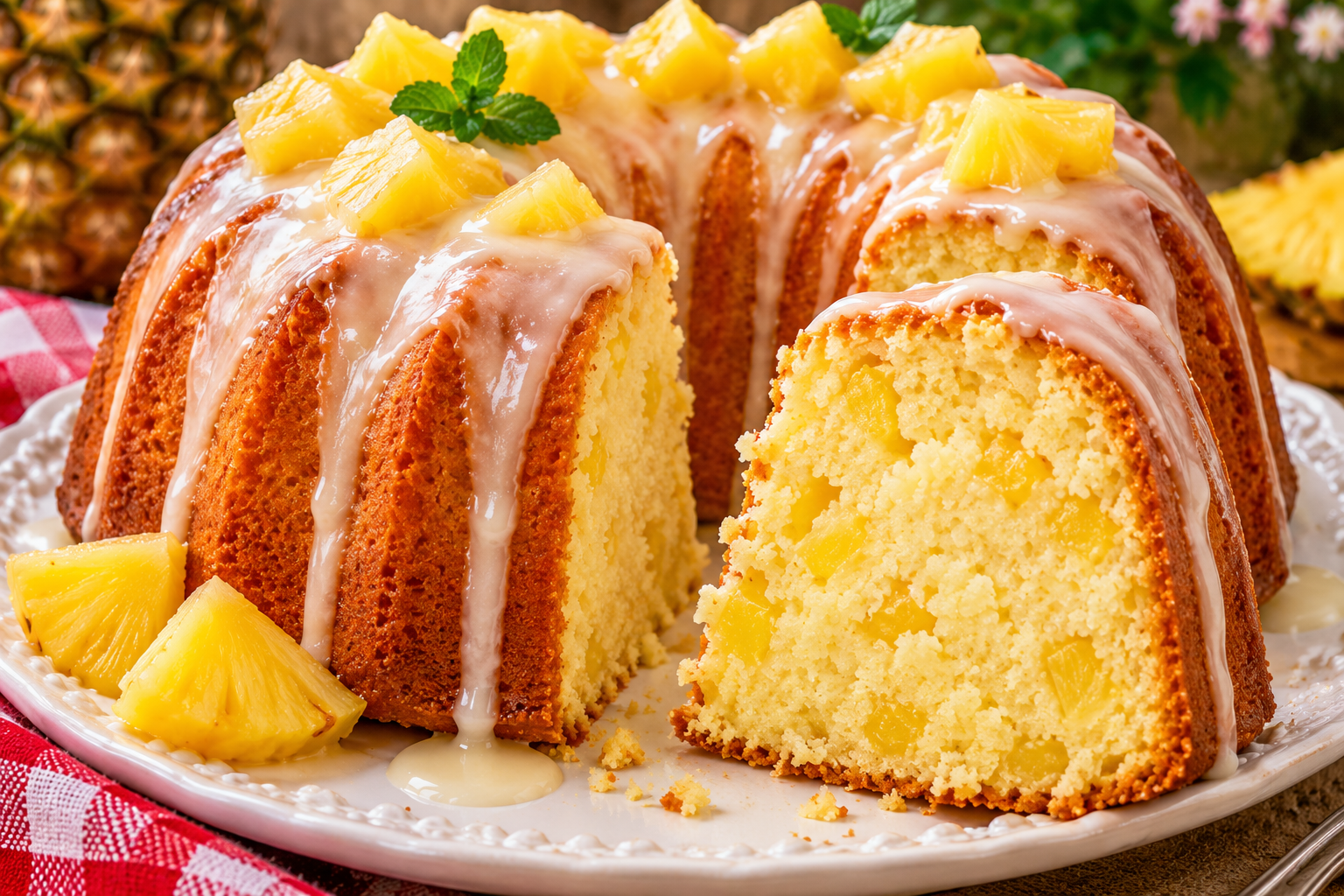
Pineapple Cream Cheese Pound Cake
This pineapple cream cheese pound cake brings together a rich, buttery crumb, little pieces of crushed pineapple and a simple pineapple glaze. It has the satisfying weight of a traditional pound cake, with a fruity sweetness that makes each slice feel particularly inviting.
Cream cheese gives the batter richness and a gentle tang, while the pineapple adds flavour throughout the cake. The finished texture should be close and tender, with clean slices that hold together beautifully on a plate.
The glaze needs only icing sugar, pineapple juice and vanilla. Drizzled over the cooled cake, it settles along the Bundt ridges and adds a sweet finish without covering the golden crust completely.
This is a lovely cake for afternoon tea, family gatherings, weekend baking or a dessert table where you want something easy to slice and share. Its decorative shape comes from the tin, so there is no need for elaborate icing or piping.
The most useful details are straightforward: soften the butter and cream cheese properly, drain the pineapple thoroughly and mix gently once the flour goes in. A little care at these stages helps the batter bake evenly and keeps excess moisture from weighing down the crumb.
Below, you will find the complete recipe, practical guidance for preparing your Bundt tin, clear signs of doneness and advice for cooling, glazing and storing your cake.
Recipe Overview
| Recipe | Pineapple Cream Cheese Pound Cake |
|---|---|
| Category | Dessert; cake |
| Style | American-style pound cake |
| Preparation time | Approximately 25 minutes, excluding ingredient softening |
| Cooking time | 70–85 minutes |
| Cooling time | 15 minutes in the tin, then until completely cool; allow approximately 2–3 hours overall |
| Glaze setting time | A few minutes; allow approximately 10 minutes |
| Total time | Approximately 4–5 hours, depending on cooling conditions |
| Servings | About 14 slices |
| Oven temperature | 325°F (165°C), conventional oven |
| Cooking method | Oven baking |
| Baking tin | 10–12 cup Bundt tin; see capacity guidance below |
| Main ingredients | Butter, cream cheese, sugar, eggs, plain flour and crushed pineapple |
Preparation, cooling, setting and total times are estimates. The supplied baking range is 70–85 minutes, but the cake’s actual doneness should determine when it leaves the oven.
Why You’ll Love This Recipe
- A rich, tender crumb: butter and cream cheese give the cake its satisfying texture.
- Pineapple throughout: crushed fruit distributes more evenly than large chunks.
- A simple finishing glaze: three ingredients make an easy topping.
- An attractive shape: the Bundt tin creates a decorative finish without complicated decorating.
- Easy portioning: the cake cuts into about 14 slices for sharing.
- A practical make-ahead dessert: bake it ahead, cool it thoroughly and glaze before serving.
- Flexible presentation: serve plain with tea or add optional accompaniments for dessert.
Ingredients
Original cup, spoon and ounce quantities are retained below. Metric equivalents are approximate; use one consistent measuring system where possible.
For the Cake
- 1 cup (2 sticks) unsalted butter, softened — approximately 227g
- 8 oz cream cheese, softened — approximately 227g
- 2 1/2 cups granulated sugar — approximately 500g
- 6 large eggs, at room temperature
- 3 cups all-purpose flour, called plain flour in the UK — approximately 360g when spooned and levelled
- 1/2 tsp baking powder
- 1/4 tsp salt
- 1 cup crushed pineapple, very well drained — measure after draining; weight varies with drainage
- 1 tsp vanilla extract
- 1/2 tsp pineapple extract, optional
For the Pineapple Glaze
- 1 cup powdered sugar, called icing sugar in the UK — approximately 120g
- 2–3 tbsp pineapple juice
- 1/2 tsp vanilla extract
For preparing the tin: you will also need a little extra grease and flour, as directed in the original method. These are separate from the measured cake ingredients.
Ingredient Notes and Substitutions
Unsalted Butter
Butter supplies flavour and helps incorporate air during creaming. It should yield to gentle finger pressure while holding its shape. Melted or very greasy butter will not cream in the same way.
Optional substitution: salted butter can be used, but the salt content varies by brand and will change the seasoning. Unsalted butter gives the most control when following the supplied recipe.
Cream Cheese
Full-fat block-style cream cheese is the most suitable choice for a rich baking batter. Softer spreadable products can contain more moisture and may produce a different result. Let the cream cheese soften enough to blend smoothly with the butter.
Low-fat cream cheese and dairy-free spreads are not equivalent substitutions in this recipe; their different water and fat content can affect the crumb.
Granulated Sugar
The original recipe uses 2 1/2 cups of granulated sugar. Besides sweetness, sugar contributes tenderness and helps the crust colour. Add it gradually so it blends into the butter and cream cheese.
Optional substitution: caster sugar can replace granulated sugar by weight. Avoid treating icing sugar as a direct replacement in the cake batter.
Eggs
The six large eggs provide structure and help bring the fat and liquid components together. Room-temperature eggs blend more readily into softened butter. Add them individually, mixing well after each addition.
Plain Flour, Baking Powder and Salt
Plain flour provides the cake’s structure. Whisking it with the baking powder and salt distributes these smaller ingredients evenly. Self-raising flour is not a direct substitute because it contains a different amount of raising agent.
For cup measurements, spoon flour into the cup and level the top instead of scooping and compacting it.
Crushed Pineapple
Use crushed pineapple rather than large chunks so the fruit can be folded evenly through the batter. Very thorough draining matters because extra juice changes the balance of liquid in this already rich cake.
Canned crushed pineapple is a convenient choice. Reserve some juice before discarding the remainder so you have enough for the glaze.
Vanilla and Optional Pineapple Extract
Vanilla rounds out the buttery flavour. The optional 1/2 tsp pineapple extract adds a more pronounced pineapple aroma. Extract strength varies, so measure carefully rather than pouring directly from the bottle.
Icing Sugar and Pineapple Juice
Icing sugar dissolves into a smooth glaze without cooking. Pineapple juice provides both liquid and flavour. Sift lumpy icing sugar before whisking, and add the juice gradually to control thickness.
Equipment You’ll Need
- A 10–12 cup Bundt tin
- A stand mixer with a paddle attachment or an electric hand mixer
- A large mixing bowl and a separate bowl for dry ingredients
- A small bowl and whisk for the glaze
- A flexible spatula
- Measuring cups and spoons, or kitchen scales for the stated metric equivalents
- A fine-mesh sieve for draining pineapple
- A pastry brush or kitchen paper for greasing the tin
- A wooden skewer or toothpick
- A wire cooling rack and a serving plate
- Oven gloves
Bundt tins vary in shape and usable capacity. A 12-cup tin gives more room than a 10-cup tin. Do not force all the batter into a smaller tin if it would exceed the manufacturer’s recommended fill level; see the detailed guidance below.
How to Make Pineapple Cream Cheese Pound Cake
-
Preheat the Oven
Preheat the oven to 325°F (165°C). Position a shelf so the Bundt tin will sit near the centre of the oven with enough space above it.
-
Prepare the Bundt Tin
Grease and flour a 10–12 cup Bundt tin thoroughly. Work into every ridge, around the central tube and along the base. Tap out loose flour.
-
Beat the Butter and Cream Cheese
In a large mixing bowl, beat the softened butter and cream cheese together until completely smooth. Scrape the bottom and sides of the bowl to remove any hidden lumps.
-
Add the Sugar Gradually
Add the granulated sugar gradually. Beat for several minutes until the mixture becomes pale and fluffy. Scrape the bowl as needed so the mixture creams evenly.
-
Incorporate the Eggs and Extracts
Add the eggs one at a time, mixing well after each addition. Mix in the vanilla extract and the optional pineapple extract.
-
Combine the Dry Ingredients
In a separate bowl, whisk together the plain flour, baking powder and salt.
-
Add the Flour Mixture
Gradually add the dry ingredients to the butter mixture, mixing only until almost combined. Use a low mixer speed to avoid overworking the batter.
-
Fold in the Pineapple
Fold in the very well-drained crushed pineapple with a spatula. Sweep down to the bottom of the bowl and turn the batter over itself until the fruit is distributed and no dry flour remains. Do not overmix.
-
Fill the Prepared Tin
Spoon or pour the batter evenly into the prepared Bundt tin. Smooth the top with a spatula, then tap the tin gently on the counter once or twice to remove large air pockets.
As an additional capacity precaution, follow your tin manufacturer’s fill guidance and generally leave at least one-quarter of the tin empty. If necessary, keep excess batter out of the Bundt tin and bake it separately in a suitable small tin; its baking time will differ.
-
Bake Until Done
Bake for 70–85 minutes, or until a toothpick inserted into the centre of the cake comes out clean or with a few moist crumbs. Test the thickest part of the cake without touching the metal tin.
If the skewer carries wet batter, continue baking and check again. If the top is browning too quickly, loosely cover it with foil as an optional protective measure.
-
Cool Briefly and Turn Out
Let the cake cool in the tin for about 15 minutes. Carefully invert it onto a wire rack or serving plate, using oven gloves because the tin will still be hot.
-
Cool Completely
Leave the cake until completely cool before glazing. The centre of a large pound cake can stay warm after the surface feels cool, so allow plenty of time.
-
Make the Glaze
Whisk together the icing sugar, 2–3 tbsp pineapple juice and vanilla until smooth. Start with the smaller amount of juice, then add more as needed for a pourable consistency.
-
Glaze and Slice
Drizzle the glaze over the cooled pound cake. Let it set for a few minutes before slicing and serving.
How to Drain Crushed Pineapple Properly
The pineapple should carry fruit flavour into the cake without bringing a puddle of juice with it. Draining is therefore part of measuring the ingredient, rather than an optional finishing detail.
- Place a fine-mesh sieve over a bowl and tip in the crushed pineapple.
- Let the free-flowing juice drain away, reserving enough for the glaze.
- Press the fruit gently with the back of a spoon to release additional liquid.
- Measure 1 cup of the drained pineapple. It should remain moist, but it should not drip freely when lifted.
Avoid blending the fruit into a purée, which changes how it disperses through the batter. Equally, there is no need to dry it until it becomes fibrous; the aim is to remove excess free liquid.
Bundt Tin Preparation, Capacity and Doneness
Protect the Decorative Ridges
A Bundt cake can stick wherever the protective coating is incomplete. Pay particular attention to narrow grooves and the central tube. After flouring, turn the tin in several directions to check for bare patches.
Check Capacity Before Filling
The supplied recipe specifies a 10–12 cup tin, but that range includes noticeably different capacities. If you are unsure of your tin’s size, measure how many cups of water it holds to the rim before preparing it, then dry it completely.
Brim capacity is not a batter fill line. Leave room for the cake to rise and follow the manufacturer’s advice. A 12-cup tin is the more forgiving choice for this substantial batter.
Use Several Signs of Doneness
Look for a set surface, a golden-brown crust and a skewer that comes out clean or with a few moist crumbs. A browned exterior alone does not confirm that the middle is cooked.
Begin checking at 70 minutes. Pineapple pieces may leave a little moisture on a skewer, so test a second nearby spot if the result is unclear. Glossy batter or a visibly wet streak means the cake needs longer.
Give the Cake Its Short Rest
The 15-minute rest helps the freshly baked cake firm up before turning out. Inverting immediately can cause tearing, while leaving it in the tin until fully cold may make release more difficult.
How to Make a Smooth Pineapple Glaze
The ideal glaze falls from a spoon in a thick ribbon and slowly settles into the surface. It should travel down the cake’s ridges while leaving a visible coating.
| Glaze problem | Likely cause | Suggested adjustment |
|---|---|---|
| Too thick to drizzle | Not enough juice | Add pineapple juice a few drops at a time and whisk again. |
| Runs straight off the cake | Too much liquid or a warm cake | Cool the cake completely; if needed, whisk a little extra icing sugar into the glaze. |
| Small white lumps | Clumped icing sugar | Sift the sugar before mixing and whisk thoroughly. |
| Disappears into the crust | The cake is still warm | Wait until the cake is cool through the centre before glazing. |
Any additional icing sugar or juice used to correct consistency is an optional adjustment beyond the original measured quantities.
Expert Baking Tips
- Soften evenly: cut the butter and cream cheese into smaller pieces to help them soften consistently.
- Keep butter cool enough to hold its shape: softness should not mean melting.
- Reserve juice early: set aside the glaze quantity before discarding drained pineapple liquid.
- Scrape the bowl: dense cream cheese can cling to the base even when the upper batter looks smooth.
- Add eggs individually: let each disappear into the batter before adding the next.
- Whisk the dry ingredients thoroughly: the small amount of baking powder needs even distribution.
- Finish with a spatula: gentle folding helps incorporate the fruit without prolonged mixing.
- Distribute batter around the tin: spoon it into several points rather than piling it all on one side.
- Tap gently: one or two light taps are enough; repeated heavy banging is unnecessary.
- Avoid opening the oven early: leave the cake undisturbed until near the start of the checking window.
- Cool on a rack where possible: airflow underneath helps moisture escape.
- Glaze on the serving plate: transfer the cooled cake first to avoid handling sticky icing later.
Common Mistakes to Avoid
| Mistake | What can happen | How to prevent it |
|---|---|---|
| Using wet pineapple | A heavy crumb or damp pockets | Drain and gently press the fruit before measuring. |
| Using cold cream cheese | Lumps remain in the batter | Soften it before beating with the butter. |
| Rushing the creaming stage | A tighter, less even crumb | Beat until pale and fluffy, scraping the bowl. |
| Compacting flour into cups | Too much flour and a dry cake | Spoon and level, or use the approximate weight provided. |
| Overmixing after adding flour | A tougher texture or tunnels | Mix only until almost combined, then fold in the fruit. |
| Overfilling the tin | Overflow or uneven baking | Check capacity and leave adequate rising space. |
| Relying only on crust colour | An underbaked centre | Test the thickest part with a skewer. |
| Glazing a warm cake | Thin glaze that soaks in | Let the cake cool completely. |
Optional Variations
These suggestions change the original recipe. Keep the main cake method unchanged unless a specific adjustment is described.
- Gentler pineapple flavour: omit the optional pineapple extract and rely on the fruit and juice.
- Unglazed pound cake: leave off the glaze for a less sweet finish.
- Lightly dusted cake: replace the glaze with a light dusting of extra icing sugar just before serving.
- Citrus-scented cake: fold in 1 tsp finely grated lemon or lime zest with the pineapple for a brighter aroma.
- Vanilla-forward cake: omit the optional pineapple extract and increase the cake’s vanilla to 1 1/2 tsp.
- Individual dessert plates: keep the cake unchanged and serve slices with separate optional toppings, allowing guests to choose their own finish.
Avoid adding generous quantities of extra fruit or liquid without adjusting the formula; this batter already contains a substantial amount of moisture and fat.
Serving Suggestions
For the simplest presentation, serve a room-temperature slice on its own with tea or coffee. The glaze provides enough sweetness and flavour for the cake to stand alone.
For a fuller dessert, optional lightly whipped cream or plain Greek yoghurt provides a soft contrast to the close crumb. Keep these accompaniments separate until serving.
Fresh pineapple or berries can add freshness and colour to individual plates. These are optional serving additions rather than ingredients in the original cake.
If you prefer ice cream, serve a small scoop beside an unglazed or lightly glazed slice so the overall dessert does not become overly sweet.
Storage, Freezing and Reheating
Room-Temperature Storage
Following the supplied storage guidance, keep the cooled cake covered at room temperature for up to 2 days. Choose a cool, dry place away from direct sunlight and heat. Refrigerate sooner in a hot kitchen.
Refrigeration
For longer storage, refrigerate in an airtight container for up to 5 days. Bring the portion you plan to serve to room temperature for a softer texture. Keep any cream, yoghurt or other perishable accompaniments refrigerated separately.
Freezing
As an optional make-ahead method, freeze the fully cooled cake unglazed for the neatest finish. Wrap the whole cake or individual slices tightly, then place in a freezer-safe container or bag. Use within approximately 2–3 months for best quality.
Defrost covered in the refrigerator, then bring the required portion to room temperature and glaze if desired. Glazed slices can also be frozen, although the icing may become sticky after thawing.
Warming Individual Slices
This cake does not need reheating. If you prefer a warm slice, microwave it in brief 5–10 second bursts, checking between each. The glaze may soften or melt, so warm unglazed slices where possible.
Making Ahead
Bake the cake a day ahead, cool completely and store covered. Add the glaze after cooling or closer to serving. Do not store raw batter as a substitute for baking ahead; bake it once mixed.
Frequently Asked Questions
1. Is this cake supposed to be dense?
Yes. Pound cake has a closer, more substantial crumb than a light sponge. It should still be tender, evenly baked and free from gummy or wet patches.
2. Should I measure the pineapple before or after draining?
Measure 1 cup after draining it very well. This gives the intended amount of fruit without including excess juice.
3. Can I use pineapple chunks?
Crushed pineapple is the original ingredient and distributes most evenly. As an optional adaptation, finely chop chunks and drain them thoroughly before measuring.
4. Can I use fresh pineapple?
Canned crushed pineapple is the more straightforward option. Fresh pineapple varies in juiciness and texture, so a finely chopped, well-drained fresh version is an untested substitution.
5. Is pineapple extract essential?
No. The supplied 1/2 tsp is optional. The cake still contains pineapple fruit, and the glaze adds pineapple juice.
6. Can I use spreadable cream cheese?
Block-style full-fat cream cheese is preferable. Spreadable products vary and may contain more water, which can affect the batter and finished crumb.
7. Why did my batter look slightly curdled after adding eggs?
The ingredients may have been at different temperatures, or the eggs may have been added too quickly. A slight split can improve once the flour is incorporated; do not try to correct it with prolonged beating after adding flour.
8. Can I reduce the sugar?
The original recipe contains 2 1/2 cups. Reducing it can affect tenderness, moisture and browning, so a reduced-sugar version would need testing. Omitting the glaze is a simpler optional way to reduce the finished cake’s sweetness.
9. Can I use self-raising flour?
It is not a direct substitute. Use plain flour with the specified 1/2 tsp baking powder to retain the original formula.
10. Will all the batter fit in a 10-cup Bundt tin?
It depends on the tin’s usable capacity and recommended fill level. A 12-cup tin provides more space. Never overfill a smaller tin just to use all the batter.
11. Can I bake this in loaf tins?
That would be an adaptation. The batter would need to be divided between appropriately sized tins, and baking times would change. The supplied 70–85 minute range applies to the Bundt method.
12. Why is the top brown while the centre is still wet?
The oven may run hot, the tin may be dark or the batter may be particularly deep. Loosely cover the top with foil and continue baking until the centre passes the skewer test.
13. Why did the cake stick?
Common causes include missed grooves during greasing, worn tin coating or unsuitable release timing. Grease and flour thoroughly, then follow the approximately 15-minute rest before turning out.
14. What causes a gummy layer near the bottom?
Excess pineapple liquid, insufficient baking or poorly combined batter can contribute. Drain the fruit, scrape the mixing bowl thoroughly and test the cake’s thickest part before removing it.
15. Why did the cake sink?
An underbaked centre, excessive liquid or an overfilled tin can leave the structure unable to hold. Check ingredient measurements and doneness before assuming the baking time alone is enough.
16. How cool should the cake be before glazing?
It should be completely cool, including through the centre. Any remaining warmth can thin the glaze and encourage it to soak into the crust.
17. Can I make the glaze in advance?
It is quickest to make just before use. If prepared ahead, cover and refrigerate it, then stir thoroughly and adjust with a few drops of juice if necessary before drizzling.
18. Are the nutritional figures exact?
No. The figures supplied with the recipe are approximate and have not been independently verified. Brands, flour measurement, slice size and glaze quantity all affect the result.
Complete Recipe Card
Pineapple Cream Cheese Pound Cake
A rich, buttery Bundt cake with crushed pineapple, cream cheese and a simple pineapple-vanilla glaze.
- Category: dessert; cake
- Style: American-style
- Method: oven baking
- Preparation: approximately 25 minutes, excluding softening
- Baking: 70–85 minutes
- Cooling: 15 minutes in the tin, then until completely cool; approximately 2–3 hours overall
- Glaze setting: a few minutes; allow approximately 10 minutes
- Total: approximately 4–5 hours
- Yield: about 14 slices
- Oven: 325°F (165°C), conventional
- Tin: 10–12 cup Bundt tin; do not exceed its recommended fill level
Cake Ingredients
- 1 cup (2 sticks) unsalted butter, softened — approximately 227g
- 8 oz cream cheese, softened — approximately 227g
- 2 1/2 cups granulated sugar — approximately 500g
- 6 large eggs, room temperature
- 3 cups all-purpose flour, or plain flour — approximately 360g when spooned and levelled
- 1/2 tsp baking powder
- 1/4 tsp salt
- 1 cup crushed pineapple, very well drained and measured after draining
- 1 tsp vanilla extract
- 1/2 tsp pineapple extract, optional
Pineapple Glaze Ingredients
- 1 cup powdered sugar, or icing sugar — approximately 120g
- 2–3 tbsp pineapple juice
- 1/2 tsp vanilla extract
Tin preparation: extra grease and flour as needed, separate from the measured batter ingredients.
Instructions
- Preheat the oven to 325°F (165°C).
- Grease and flour a 10–12 cup Bundt tin thoroughly, covering the grooves and central tube.
- In a large mixing bowl, beat the softened butter and cream cheese together until completely smooth. Scrape the bowl as needed.
- Add the granulated sugar gradually, then beat for several minutes until pale and fluffy.
- Add the eggs one at a time, mixing well after each addition.
- Mix in the vanilla extract and optional pineapple extract.
- In a separate bowl, whisk together the flour, baking powder and salt.
- Gradually add the dry ingredients to the butter mixture. Mix only until almost combined.
- Fold in the very well-drained crushed pineapple with a spatula until evenly distributed and no dry flour remains. Do not overmix.
- Spoon or pour the batter evenly into the prepared tin, smooth the top and tap gently on the counter once or twice to remove large air pockets. Follow the tin’s fill guidance and generally leave at least one-quarter empty. Bake any excess separately in a suitable small tin, allowing for a different baking time.
- Bake for 70–85 minutes, or until a toothpick inserted into the thickest part comes out clean or with a few moist crumbs. Continue baking if wet batter remains. Loosely cover with foil if browning too quickly.
- Cool in the tin for about 15 minutes, then carefully invert onto a wire rack or serving plate.
- Allow the cake to cool completely before glazing.
- Whisk the icing sugar, pineapple juice and vanilla together until smooth. Begin with 2 tbsp juice and add more towards 3 tbsp as needed; add a little extra only if necessary for a pourable consistency.
- Drizzle over the cooled cake. Let the glaze set for a few minutes before slicing.
Recipe Notes
- Drain the pineapple extremely well and reserve juice for the glaze.
- Use softened butter and cream cheese, plus room-temperature eggs.
- Keep mixing brief after adding the flour.
- Bake low and slow for a classic, close pound-cake texture.
- Cool completely so the glaze remains visible.
- Store covered at room temperature for up to 2 days, or refrigerate for up to 5 days. Refrigerate sooner in a hot kitchen.
- Bring slices to room temperature before serving for the softest texture.
- All metric equivalents and preparation, cooling and total times are approximate.
Nutritional Information
Servings: about 14 slices.
The following approximate values were supplied with the original recipe and are reproduced without independent verification. They may understate energy and carbohydrates for the full ingredient quantities; use a calculation based on your products and actual portions if accuracy is required.
| Nutrient | Supplied estimate per slice |
|---|---|
| Calories | 430 kcal |
| Protein | 6g |
| Carbohydrates | 53g |
| Total fat | 22g |
| Saturated fat | 13g |
| Fibre | 1g |
| Sodium | 150mg |
Nutrition values are estimates and may vary depending on slice size and glaze amount.
Recipe hashtags: #PineappleCake #CreamCheesePoundCake #BundtCake #HomemadeBaking #DessertRecipes